Why We Choose the Books We Choose
Why we choose the books we choose
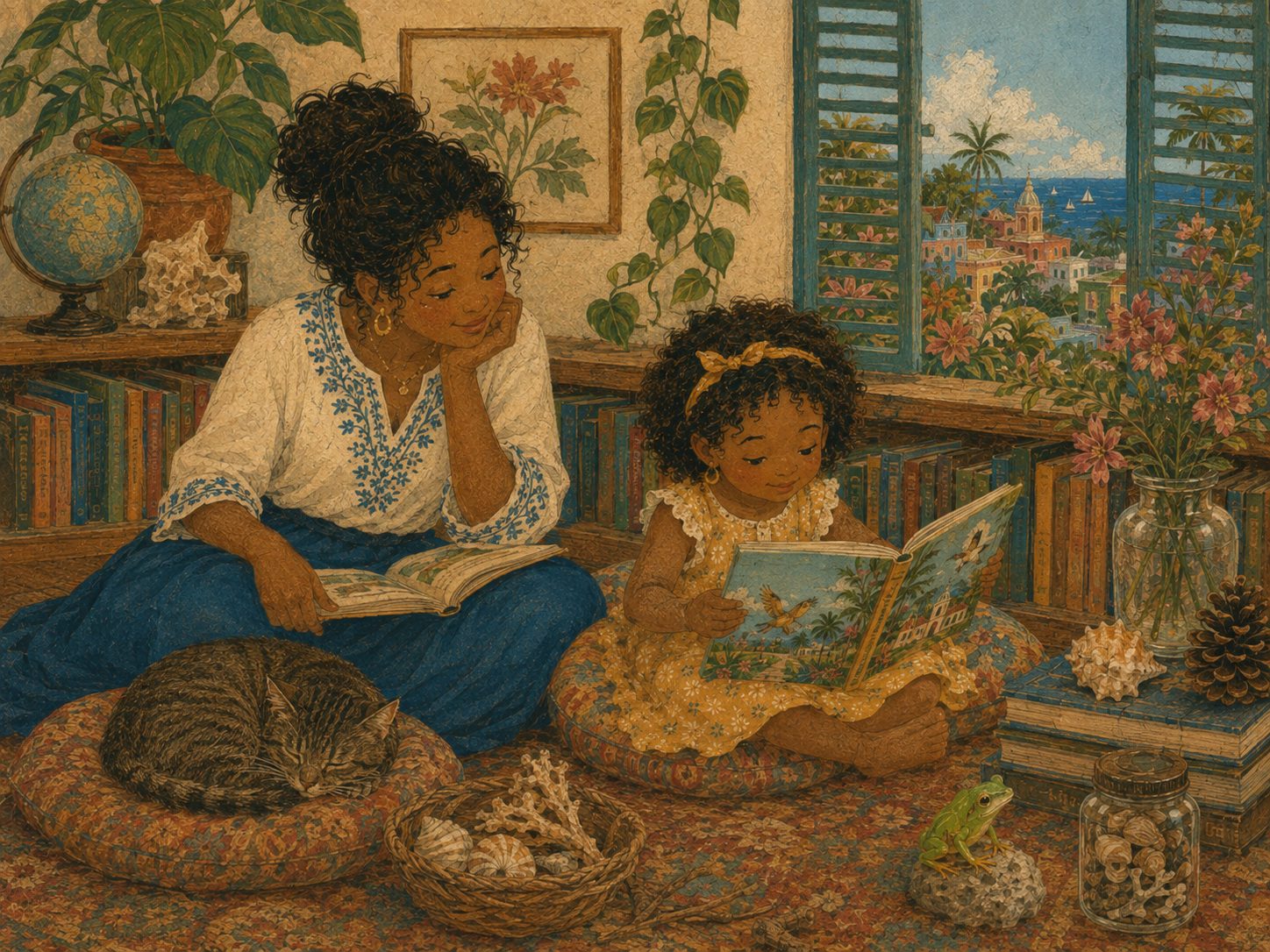
That suspended moment before a book ever reaches a child's hands. An adult is standing somewhere with the book open, turning pages, deciding. It doesn't feel like much at the time. But those small decisions add up to a classroom library, and a classroom library becomes part of how a child comes to understand the world and their own place in it.
I'm not in the classroom every day anymore. These days, I get to sit alongside our guides while they choose books for their shelves, and it has become one of my favorite parts of the work. So I wanted to share what we're looking for, and why.
Mirrors and windows
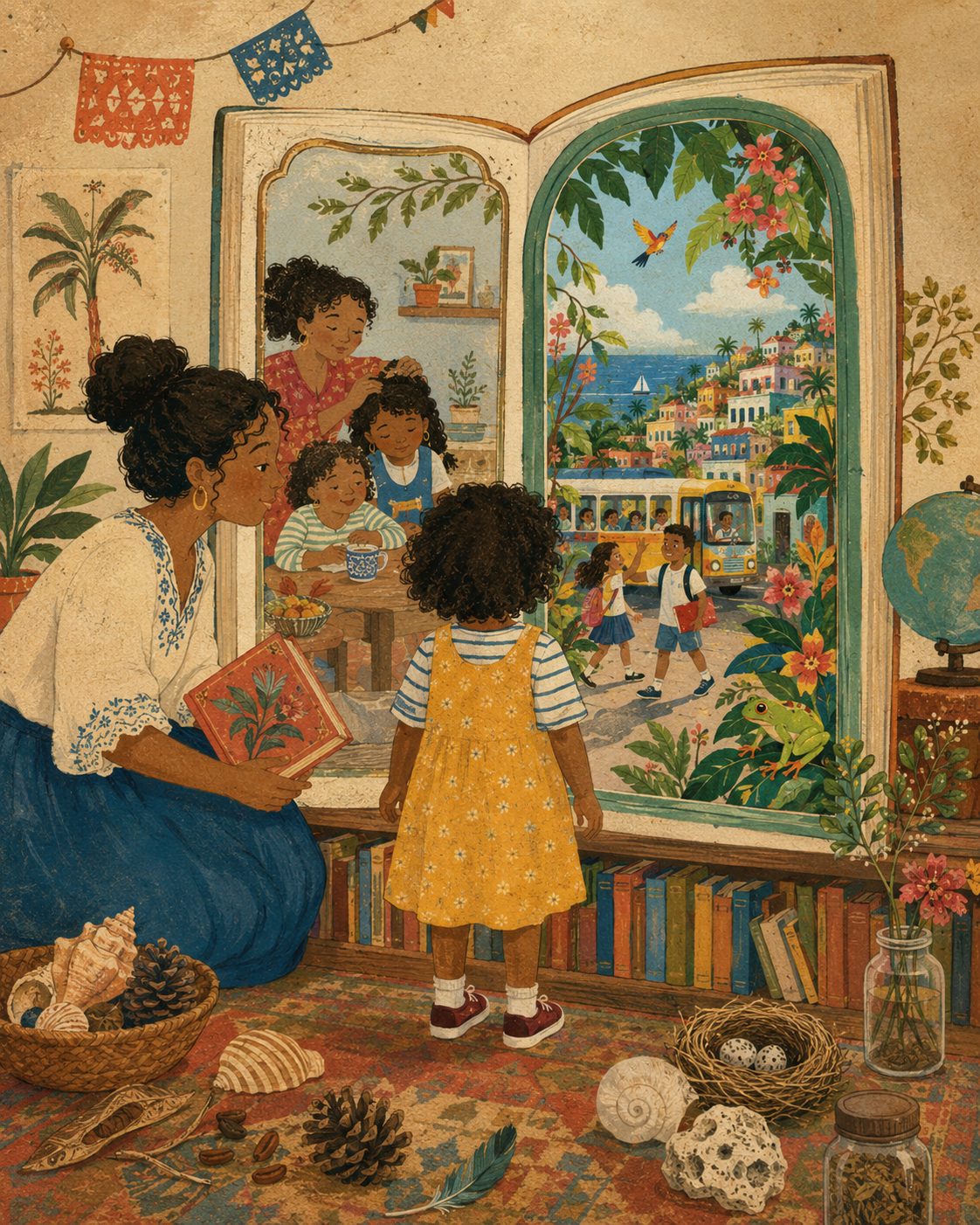
The scholar Rudine Sims Bishop gave us language for this that I've never been able to improve on. Books can be mirrors, where a child catches sight of their own face, their own family, their own kitchen table. Books can be windows through which a child looks out at a life that isn't theirs. And sometimes a book becomes a sliding glass door, and the child walks right through it.
A child needs both. A library made only of mirrors is a small room. A library made only of windows leaves a child on the outside of their own education, always visiting, never arriving.
I think about this because of my own hair. I grew up in Puerto Rico hearing about “good hair” and “bad hair,” and I understood very early which one was on my head. Nobody sat me down and taught me that. I absorbed it, the way children absorb everything, from the air around me.
Years later, I read Hair Love by Matthew A. Cherry, with illustrations by Vashti Harrison, and I sat with it for a long time. A father learning to do his daughter's hair. Curls and puffs and braids drawn with such care that they are clearly the point of the book, not a problem the book is solving. I wish that book had been on a shelf I could reach when I was four.
And I notice something else in it now: a child from any background can find their way into that story, because being cared for by an adult who is trying hard is a feeling every child recognizes.
Beauty comes first
We pay close attention to illustrations, sometimes before we read a word. Beautiful illustrations invite children to slow down and look. They notice a shadow, a bird in the corner, a face that has changed between one page and the next.
We choose books that appeal to a child's sense of beauty, awe, and wonder, because those senses are awake in the first six years in a way they may never be again.
Real words for real things
Children between three and six are in a sensitive period for language. They are hungry, not for simplified words, but for the actual ones.
I had a four-year-old boy in my class who learned to zip his own coat and then became fascinated by the zipper itself. We looked it up together and found the real names: slider, pull, teeth, tape, starting box, and insertion pin. For weeks afterward, I would hear him narrating his own coat at the door. The slider goes on the insertion pin. He wasn't performing for me. He was naming his world, which is one of the great pleasures of being small.
This is why our shelves hold so much nonfiction. Books about seeds, eggs, and nests, and how things work, with photographs and precise vocabulary, often sit next to a basket of real pinecones or shells that the children can hold.
Poetry belongs to the body
Poetry is not decoration for us. Children love rhythm and repetition, and they love hearing the same poem over and over, which is worth remembering when we're tempted to always offer something new. Familiarity is not boredom for a young child. It's mastery.
We say poems with gestures. We act them out with our whole bodies, ducklings waddling over the hills and coming back one fewer than before. Sometimes we invite children to illustrate a poem, and what they draw tells us what they understood, which is not always what we assumed.
We choose poems that are sensory and rich but still within reach. The more abstract ones can wait for older children who have the inference skills and vocabulary to meet them.
Books that help with big feelings
Children this age are constructing themselves, and part of that construction is learning that a feeling has a name, that it moves through you, and that it ends.
Books like When Sophie Gets Angry, Really, Really Angry by Molly Bang, Listening to My Body by Gabi Garcia, and In My Heart: A Book of Feelings give children vocabulary for something they are already experiencing without words. A child who can say “my hands are hot and my chest is tight” has more choices than a child who can only throw the blocks.
These books don't teach children to be calm. They teach children that they are not alone in there.
Discernment, not avoidance
We're careful about what we put in front of young children. That's part of respecting them. But careful is not the same as narrow. Children can encounter challenging and unfamiliar topics when the language and illustrations are right for their age.
Last Stop on Market Street by Matt de la Peña talks about who has what and who doesn't, and it never turns into a lesson. Julián Is a Mermaid by Jessica Love shows a grandmother meeting her grandchild's imagination with acceptance rather than correction, and it does so almost entirely through pictures.
One more thing we watch for: we don't want any culture on our shelves represented only by its hardships. Children should meet the fullness of the human experience, the struggles and also the birthdays, the food, the jokes, the ordinary Tuesday afternoons.
Books aren't there to tell children what to think. They're there to make children curious.
If you'd like to bring some of this home
Read it again. And again. The fifteenth reading is doing something the first one couldn't.
Let your child hold the book and turn the pages, even slowly, even out of order.
Resist the quiz at the end. You'll learn more from what they bring up on their own three days later.
Follow the interest, even a strange one. Trash trucks, volcanoes, zippers. Interest is the engine, and we don't have to build it, only feed it.
And when you can, choose books where somebody in the pictures looks like your family, and books where nobody does.
Why any of this matters
What we're really after is a child who feels a deep sense of belonging and significance, at home and here at school. Belonging says there's a place for me. Significance says what I do and who I am matters.
The best authors and illustrators already know this. You can feel it in their books. They see children as intelligent, capable, and curious, and they write accordingly.
We try to choose books that agree with them. And we try to send children the same message the good books send, which is that their own ordinary life, the coquí outside the window or the walk to the bus stop, or the father learning to do their hair, is already a story worth telling.
A few we love
Hair Love (Matthew A. Cherry) · Alma and How She Got Her Name (Juana Martinez-Neal) · The Name Jar (Yangsook Choi) · My Papi Has a Motorcycle (Isabel Quintero) · Families, Families, Families! (Suzanne Lang)
Jabari Jumps (Gaia Cornwall) · The Rabbit Listened (Cori Doerrfeld) · When Sophie Gets Angry, Really, Really Angry (Molly Bang) · Listening to My Body (Gabi Garcia)
An Egg Is Quiet and A Seed Is Sleepy (Dianna Hutts Aston) · Over and Under the Pond (Kate Messner) · If You Find a Rock (Peggy Christian) · Owl Moon (Jane Yolen)
Last Stop on Market Street (Matt de la Peña) · Julián Is a Mermaid (Jessica Love) · Dreamers (Yuyi Morales) · Fry Bread (Kevin Noble Maillard) · Watercress (Andrea Wang) · The Proudest Blue (Ibtihaj Muhammad and S. K. Ali)